Uncategorized

UConn at ASHE Highlights

UConn faculty, students, and post-docs from the Department of Educational Leadership, the HESA program, and Office of Diversity & Inclusion will be involved as presenters and volunteers during this year’s annual ASHE (Association for the Study of Higher Education) virtual conference on November 18-21 and pre-conference for the Council for Ethnic Participation (CEP) on November 13. Ten of our faculty, recent graduates, and graduate students from UConn will present 12 papers and interactive symposia and serve as discussant or chair on five paper sessions and interactive symposia. You can see a full overview of UConn participation in the ASHE Conference here.  Our faculty and students will be presenting on a wide variety of research and scholarship that enhances the study of higher education within the theme of Advancing Full Participation. We asked some of our faculty and students three quick questions about the work that they will be presenting during the conference.

“Making Space for Community, Support and Healing in Racial Equity Higher Education Work”

Dr. Milagros Castillo-Montoya, Assistant Professor of Higher Education and Student Affairs.

Why did you undertake this work?

As a community of racially minoritized faculty, it is important to create space for community, support and healing. I experienced this in a profound way during a trip to the Netherlands with amazing higher education scholars who exemplified what this means and feels like. I want to share about how powerful that experience can be.

What are the important takeaways?

With a strong sense of community, racially minoritized faculty can thrive. As such, having space for this community to develop is critical to our well-being in the academy.

What do you hope practitioners can learn from this work?

I hope practitioners will learn that creating space for racially minoritized folx to connect and create community has to be more of an institutional priority.

“How Does Whiteness “Show Up” in Student Affairs Work? A Literature Analysis and Framework for Practice”

Ashley N. Robinson, PhD Candidate, Leadership and Education Policy

Why did you undertake this work?

Research shows that efforts for racial equity in higher education consistently fail because racism and white supremacy pervade higher education, a social institution built on exclusionary and racist foundations. I wanted to explore how exactly racism and white supremacy are being made real, institutionally, on a day-to-day basis? What is happening with actual texts—written policies, forms, visuals, media representations—as they land in people’s real, everyday work, that continually creates situations in which educators who really want to enact antiracist responses to racist harms end up doing things that uphold institutional racism instead?

What are the important takeaways?

I offer a framework to interrogate the tensions of responding to racist harms toward the aim of uncovering how the discourse of whiteness might show up in textually mediated ways in response work. The framework consists of nine concepts that are characteristic of the discourse of whiteness in student affairs work, offers a literature-informed description of each concept, and analytical questions that foreground the materiality of the concept related to responding to racist harms.

What do you hope practitioners can learn from this work?

In practice, I recommend using this framework to analyze texts like incident reports, incident reporting forms, protocols, procedures, policies, training materials, investigation reports, meeting notes, budget documents, and public statements. The purpose of such textual analysis is two-fold: firstly, to name and uncover the specific ways that attempts to respond to racist harms may, in fact, uphold white supremacy and institutional racism, and secondly, to empower student affairs educators at all levels to transform their approaches to responding to racist harms.

“Decolonizing Academic Spaces: Advancing Full Participation Globally to Promote Racial Equity in Postsecondary Education”

Dr. Saran Stewart, Associate Professor & Program Director of Higher Education and Student Affairs

Dr. Frank Tuitt, Professor of Higher Education and Student Affairs & Chief Diversity Officer

Saran Steward, headshot

Why did you undertake this work?

Central to our work is developing critical consciousness and to do that, we argue you must confront and disrupt the colonizers’ gaze and epistemologies.

What are the important takeaways?

  • Decolonising the mind through ways of knowing and knowledge construction;
  • Decolonising pedagogy;
  • Decolonising structures, policies and practices; and
  • Reimagining the academy from a decolonised lens. 

What do you hope practitioners can learn from this work?

We hope that the presentation will provide concrete examples to create decolonised spaces both in and out of the classroom where minoritised students can engage in learning that suggest their lives and lived experiences really matter. 

“Masculinities as Barriers to Full Participation: A Longitudinal Study on Fraternity Masculine Norms and Hazing Motivations”

Dr. Adam McCready, Assistant Professor In-Residence, Higher Education & Student Affairs

Why did you undertake this work?

Surprisingly little is known about how men are socialized to perform gender during their undergraduate experiences. Looking specifically at fraternities, fraternity leaders often claim that these organizations “make better men”, but these groups are associated with troubling outcomes like hazing.

What are the important takeaways?

While fraternity men reported statistically significantly lower conformity to misogyny after three years of fraternity membership, their conformity to eight other masculine norms and their hazing attitudes did not change significantly over this time period. Increased adherence to misogyny and risk-taking over three years predicted increased endorsement of hazing.

What do you hope practitioners can learn from this work?

Because fraternities may recruit men who share similar attitudes toward hazing and adhere to similar gender performances, practitioners may want to focus their interventions on membership recruitment efforts. In addition, interventions designed to address misogyny and risk-taking among fraternity men may also mitigate hazing attitudes.

Nix (’17) and Peralta (’17) Present at New England Latinx Student Leadership Conference

HESA PeraltaNELSLC

Jeronima (Niimo) Nix (HESA Class of 2017) and Yihra Peralta (HESA Class of 2017) presented at the 13th annual New England Latinx Student Leadership Conference at Hampshire College. This year’s theme for the conference was “#DecolonizeLatinx.”

Nix and Peralta’s workshop was titled, “Navigating White Spaces: Self-Care & Success.” Additional information about other presenters, presentation, and the history of the conference itself can be found at the conference’s website: http://nelslc.com/.

Thompkins (’16) and Baldassario (’16) Win NASPA Case Study Competition

Michael Thompkins Ryan Baldassario

Michael Thompkins and Ryan Baldassario, both members of the HESA Class of 2016, recently won the second-year graduate student Case Study Competition at the 2016 NASPA Annual Conference in Indianapolis, IN.

Competing against eight other teams of second-year graduate students from graduate preparation programs across the country, Michael and Ryan incorporated theory, research, national context, and practical solutions to address the various issues addressed in the case. Michael and Ryan joined the winners of the first-year case study competition to present their approach as an educational session at the NASPA Annual Conference.

Additional information about the Case Study Competition can be found on the NASPA website here: http://conference2016.naspa.org/engage/case-study-competition.

Dr. Castillo-Montoya Recognized with 2016 Emerging Scholar Award (ACPA)

MCM Award Announcement 2.23.16

Dr. Milagros Castillo Montoya, Assistant Professor of Higher Education and Student Affairs in the Department of Educational Leadership has been selected as one of five national recipients of the 2016 Emerging Scholars Award by College Student Educators, International (ACPA).

ACPA notes, “the Emerging Scholars Program supports, encourages, and honors early-career individuals who are emerging as contributors to student affairs and higher education scholarship and who are pursuing research initiatives congruent with the mission, interests, and strategic goals of ACPA.” This is one of the ACPA’s major awards and will be presented to Dr. Castillo-Montoya on March 6, 2016 at its annual convention in Montreal, Canada. The award will support Dr. Castillo-Montoya’s research on the development of inclusive practices for teaching diverse college students.

Dr. Rincón and Dr. Evanovich Awarded Provost’s Teaching Innovation Grant

Blanca 1.15.16Evanovich

Dr. Blanca Rincón and Dr. Justin Evanovich were awarded a $5,000 Provost’s Teaching Innovation Grant for the UNIV 1820 Intergroup Dialogue on Race course they will be co-developing and co-teaching this fall. The Provost’s Teaching Innovation Mini Grant Competition is designed to support faculty innovation around teaching and student learning.

While both faculty members are housed within the Department of Educational leadership, Dr. Rincón is an assistant professor for the HESA program while Dr. Evanovich is an assistant clinical professor for the Sports Management program.

Dr. Rincón Selected as a UCONN Service Learning Faculty Fellow

Blanca 1.15.16

Dr. Blanca Rincón will join nine faculty across the University of Connecticut as a 2016 Service Learning Faculty Fellow. The Service Learning Faculty Fellows program offered by the Office of Public Engagement recognizes faculty engaged in the pedagogy of service learning, a high-impact pedagogy that aims to bridge the needs of communities with active learning opportunities for students. Dr. Rincón teaches Assessment, Evaluation, and Research in Student Affairs, a service learning course where students work on a year-long assessment project for a UConn office or program (Learn more here: http://hesa.uconn.edu/edlr-5102-5103-review/), and is in the process of developing a new course for the Fall 2016 semester, Access to Higher Education.

Dr. Castillo-Montoya to Serve on CHAS Panel at Trinity College

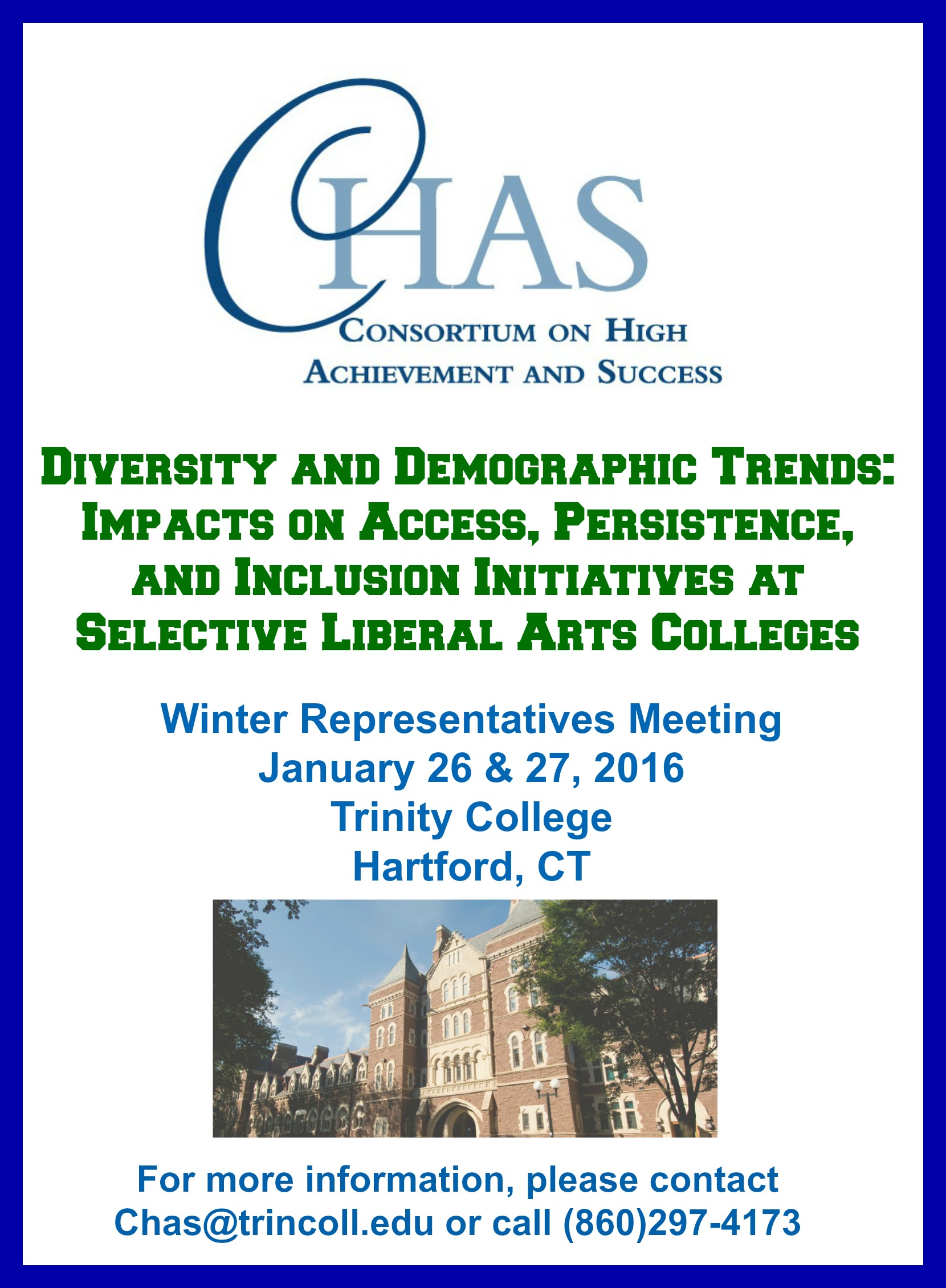
Dr. Milagros Castillo-Montoya will serve as a panelist for the Consortium on High Achievement and Success (CHAS) Winter Representatives Meeting. Dr. Castillo-Montoya will work with fellow panelists to discuss topics revolving the meeting’s theme, “Diversity and Demographic Trends: Impacts on Access, Persistence, and Inclusion Initiatives at Selective Liberal Arts Colleges.”

The CHAS Winter Representatives Meeting will be held January 26-27, 2016 at Trinity College in Hartford, CT. If interested in attending the meetings or to learn more, please contact chas@trincoll.edu or call (860) 297-4173.

View the program flyer here.

Dr. Castillo-Montoya to Serve as Panelist for UConn Husky Sport Panel Discussion

On Thursday, January 14, Dr. Milagros Castillo-Montoya will serve as a panelist for a discussion focusing on diversity in teaching and learning. This panel is being hosted by a another program housed in the Department of Educational Leadership, Husky Sport, and will be followed by breakout sessions as well. Dr. Castillo-Montoya will be joined by Dr. Erica Fernandez, Dr. Erik Hines, and Dr. Tamika La Salle. Dr. Jennifer McGarry, chair of the Educational Leadership department, will moderate the panel.

A detailed breakdown of the event can be found at the following link: Diversity in Teaching and Learning Panel

Information about RSVP instructions can be found using this form.