Web cookies (also called HTTP cookies, browser cookies, or simply cookies) are small pieces of data that websites store on your device (computer, phone, etc.) through your web browser. They are used to remember information about you and your interactions with the site.
Purpose of Cookies:
Session Management:
Keeping you logged in
Remembering items in a shopping cart
Saving language or theme preferences
Personalization:
Tailoring content or ads based on your previous activity
Tracking & Analytics:
Monitoring browsing behavior for analytics or marketing purposes
Types of Cookies:
Session Cookies:
Temporary; deleted when you close your browser
Used for things like keeping you logged in during a single session
Persistent Cookies:
Stored on your device until they expire or are manually deleted
Used for remembering login credentials, settings, etc.
First-Party Cookies:
Set by the website you're visiting directly
Third-Party Cookies:
Set by other domains (usually advertisers) embedded in the website
Commonly used for tracking across multiple sites
Authentication cookies are a special type of web cookie used to identify and verify a user after they log in to a website or web application.
What They Do:
Once you log in to a site, the server creates an authentication cookie and sends it to your browser. This cookie:
Proves to the website that you're logged in
Prevents you from having to log in again on every page you visit
Can persist across sessions if you select "Remember me"
What's Inside an Authentication Cookie?
Typically, it contains:
A unique session ID (not your actual password)
Optional metadata (e.g., expiration time, security flags)
Analytics cookies are cookies used to collect data about how visitors interact with a website. Their primary purpose is to help website owners understand and improve user experience by analyzing things like:
How users navigate the site
Which pages are most/least visited
How long users stay on each page
What device, browser, or location the user is from
What They Track:
Some examples of data analytics cookies may collect:
Page views and time spent on pages
Click paths (how users move from page to page)
Bounce rate (users who leave without interacting)
User demographics (location, language, device)
Referring websites (how users arrived at the site)
Here’s how you can disable cookies in common browsers:
1. Google Chrome
Open Chrome and click the three vertical dots in the top-right corner.
Go to Settings > Privacy and security > Cookies and other site data.
Choose your preferred option:
Block all cookies (not recommended, can break most websites).
Block third-party cookies (can block ads and tracking cookies).
2. Mozilla Firefox
Open Firefox and click the three horizontal lines in the top-right corner.
Go to Settings > Privacy & Security.
Under the Enhanced Tracking Protection section, choose Strict to block most cookies or Custom to manually choose which cookies to block.
3. Safari
Open Safari and click Safari in the top-left corner of the screen.
Go to Preferences > Privacy.
Check Block all cookies to stop all cookies, or select options to block third-party cookies.
4. Microsoft Edge
Open Edge and click the three horizontal dots in the top-right corner.
Go to Settings > Privacy, search, and services > Cookies and site permissions.
Select your cookie settings from there, including blocking all cookies or blocking third-party cookies.
5. On Mobile (iOS/Android)
For Safari on iOS: Go to Settings > Safari > Privacy & Security > Block All Cookies.
For Chrome on Android: Open the app, tap the three dots, go to Settings > Privacy and security > Cookies.
Be Aware:
Disabling cookies can make your online experience more difficult. Some websites may not load properly, or you may be logged out frequently. Also, certain features may not work as expected.
Dr. Blanca Rincón will join nine faculty across the University of Connecticut as a 2016 Service Learning Faculty Fellow. The Service Learning Faculty Fellows program offered by the Office of Public Engagement recognizes faculty engaged in the pedagogy of service learning, a high-impact pedagogy that aims to bridge the needs of communities with active learning opportunities for students. Dr. Rincón teaches Assessment, Evaluation, and Research in Student Affairs, a service learning course where students work on a year-long assessment project for a UConn office or program (Learn more here: http://hesa.uconn.edu/edlr-5102-5103-review/), and is in the process of developing a new course for the Fall 2016 semester, Access to Higher Education.
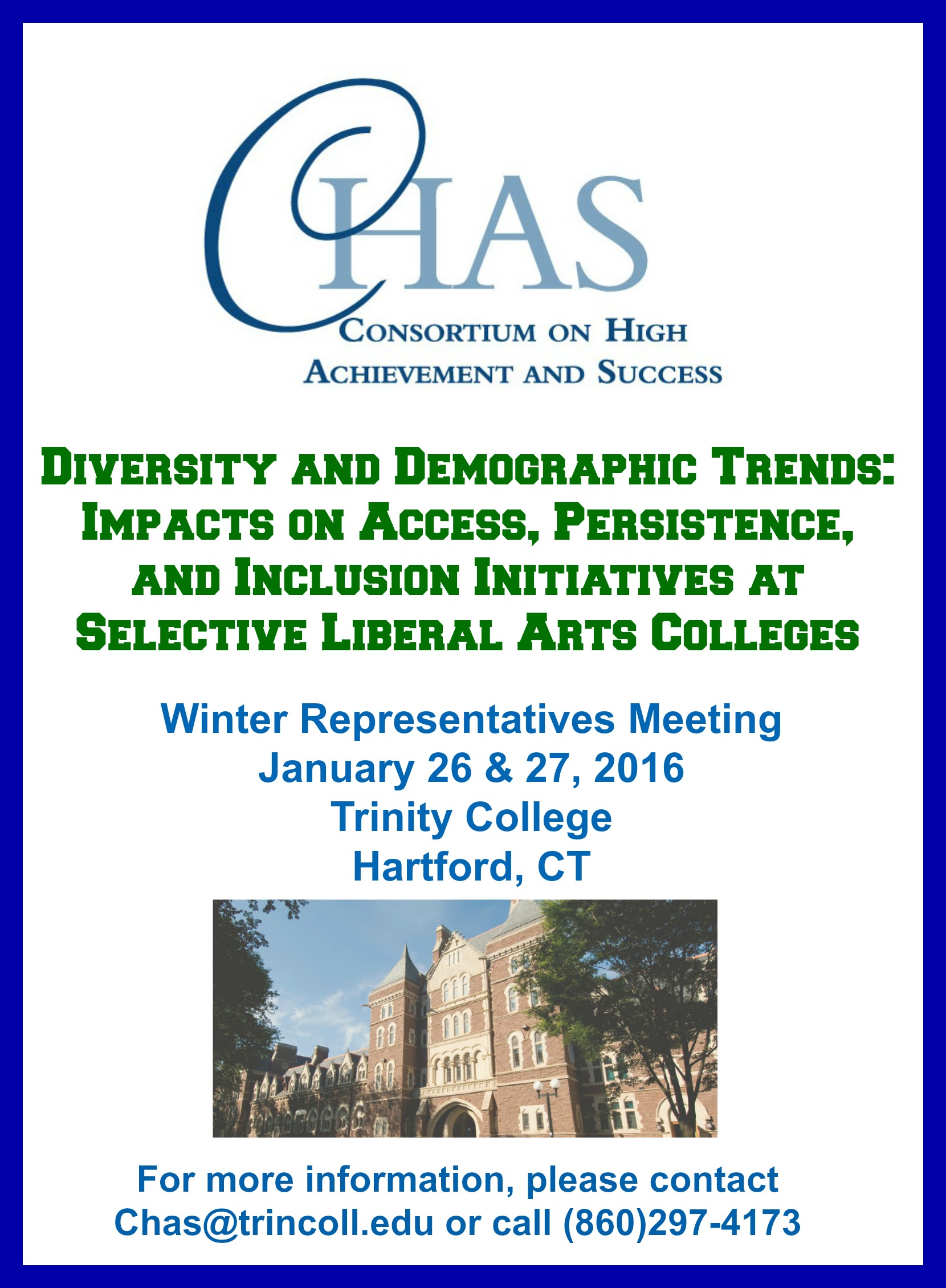
Dr. Milagros Castillo-Montoya will serve as a panelist for the Consortium on High Achievement and Success (CHAS) Winter Representatives Meeting. Dr. Castillo-Montoya will work with fellow panelists to discuss topics revolving the meeting's theme, "Diversity and Demographic Trends: Impacts on Access, Persistence, and Inclusion Initiatives at Selective Liberal Arts Colleges."
The CHAS Winter Representatives Meeting will be held January 26-27, 2016 at Trinity College in Hartford, CT. If interested in attending the meetings or to learn more, please contact chas@trincoll.edu or call (860) 297-4173.
View the program flyer here.
On Thursday, January 14, Dr. Milagros Castillo-Montoya will serve as a panelist for a discussion focusing on diversity in teaching and learning. This panel is being hosted by a another program housed in the Department of Educational Leadership, Husky Sport, and will be followed by breakout sessions as well. Dr. Castillo-Montoya will be joined by Dr. Erica Fernandez, Dr. Erik Hines, and Dr. Tamika La Salle. Dr. Jennifer McGarry, chair of the Educational Leadership department, will moderate the panel.
A detailed breakdown of the event can be found at the following link: Diversity in Teaching and Learning Panel
Information about RSVP instructions can be found using this form.
As part of the Public Discourse Project, overseen by the Humanities Institute in the University of Connecticut's College of Liberal Arts and Sciences, faculty across the university have been awarded grants to conduct research aimed at exploring new means to create meaningful public discourse in our country's currently divisive culture.
One HESA faculty member, Dr. Milagros Castillo-Montoya, will be the principle investigator for the following project:
Asset Assessment, Campus Collaboration, and Facilitator Professional Development for Intergroup Dialogue
An environmental assessment of programs in the Neag School of Education engaging students and staff in advancing dialogue on social justice, equity, and intergroup differences to better understand existing resources and to establish what gaps exist in professional development for facilitating dialogue across differences.
More details about the full list of projects included in the Public Discourse Project can be found here: http://today.uconn.edu/2015/12/research-projects-explore-meaningful-public-discourse/
The following members of our HESA Faculty group have received letters of recognition from Provost Mun Choi and Vice Provost for Academic Affairs Sally Reis for excelling in their teaching evaluations:
Dr. Milagros Castillo-Montoya
Catherine Cocks, M.A.
Daniel Doerr, M.A.
Dr. Marijke Kerhhahn
Dr. Sue Saunders
Dr. Christine Wilson
These instructors are among a select group of faculty whose ability to engage their students' curiosity and spirit of inquiry is highly regarded in evaluations completed by their students.
Interested in learning more about our faculty's interests, backgrounds, and higher education experiences? Check out our HESA Faculty page!
Thanks to the efforts of Dr. Milagros Castillo-Montoya and UConn's Puerto Rican and Latin American Cultural Center, UConn HESA is happy to visit with Dr. Kenny Nienhusser on November 19, 2015.
Dr. Nienhusser is an Assistant Professor in the Doctoral Program in Educational Leadership in the Department of Education at the University of Hartford. Dr. Nienhusser will present on, “Undocumented Students’ Postsecondary Education Access: The Role of Policies and Institutional Agents in High Schools and Higher Education Institutions.” This presentation will describe the landscape of undocumented students’ college access by focusing on what this population has encountered in high schools and postsecondary education institutions in their efforts to gain greater higher education participation.
Peter F. Lake, professor of law and director of the Center for Higher Education Law and Policy at Stetson University College of Law, will be visiting UConn on October 20 and October 21. At 4:00 PM on Tuesday, October 20, Lake will be speaking at the Konover Auditorium in the Dodd Center about "Freedom of Speech in a Civil Society," and will engage in a Q & A session with audience members.
On October 21, Lake will share his insight on higher education law and policy in a close knit session with current students of the UConn HESA Masters Program. We are grateful to have this level of interaction with a leader in the field!
Lake is an internationally-recognized expert on higher education law and policy and has been quoted or referred to in the New York Times, Wall Street Journal, USA Today, Chicago Sun Times, The Chronicle of Higher Education, various reported legal decisions including the supreme courts of Virginia and Florida, and the most recent Restatement of the Law of Torts. He has appeared on major television networks such as ABC and CNN.
This academic year will be the final year at UConn for current Program Director, Dr. Sue Saunders, as she will be retiring in June 2016. Though all of us at HESA are sad to see Sue leave UConn, we are happy that she is doing what is best for her, and excited to see what else lies ahead! Though the news is bittersweet, Sue shares considerable gratitude for having the privilege of serving as a student affairs administrator and faculty member for 43 years.
Her career includes service as a program coordinator and faculty member in the College Student Affairs Administration Program at the University of Georgia. In addition to teaching and research positions, Dr. Saunders has served as the Dean of Student Affairs (CSAO) at Lycoming College (PA), as Dean of Students and as Executive Assistant to the President and Board of Trustees at Longwood University (VA), and in other administrative positions in Virginia, Georgia, and West Virginia. Her Ph.D. in counseling and student personnel services is from the University of Georgia. She is the author of more than 45 publications, including Supervising New Professionals in Student Affairs (2003) and Learning Through Supervised Practice in Student Affairs (2014), both written with colleagues from Virginia Tech and the University of Georgia. More information about Sue can be found here.
Though we would love to continue celebrating, Sue regularly reminds us that we've plenty of work left to do this academic year!
Congratulations to our affiliate faculty member, Dr. Jen Lease Butts, on being selected to serve as an outside reviewer for the Journal of College Student Development, one of the world's leading journals in higher education.
Dr. Lease Butt's topical and methodological expertise will add to the already strong JCSD review team. We wish her the best of luck with this new challenge!
HESA’s newest faculty member, Dr. Blanca Rincón, has been selected to join the Review Board for the Research in Brief and On the Campus sections of the Journal of College Student Development. JCSD is one of the world’s leading journals on higher education and the official journal of the American College Personnel Association.